博文
科学家特质及结构模型  精选
精选
||
科学家特质及结构模型
周 健
本文是在十年前开始鼓捣的,起初是想讨论在中文语境中十分流行的“科学精神”。然而,在后来的投稿过程中,收到了几位审稿人的反馈意见,他们都对使用“科学精神(Science Spirit)”感到迷惑不解,甚至说使用 “Spirit”一词让人联想到宗教。于是,我们在后续的文稿迭代修改中将“科学精神”演绎成了“科学家特质”。文章在最近的一次期刊同行评议中,得到了编辑和审稿人的关注,尤其是其中的一位审稿人,对手稿提出了超过20条的、全面而深刻的意见和建议,体现出了良好的专业精神和上乘的的科学研究素养。对此,我和合作者都心存感激!我们依据审稿人的意见修改了手稿,经过审稿人和编辑的第二轮审阅,手稿被顺利接收发表(全文下载)。本文聚焦于科学家的总体特质的讨论,意在给“科学家具有那些综合特征?人们应该具备什么属性才更有可能成为科学家?如何为想在未来成为科学家的孩子们指出一些值得努力的方向?用什么标准来选拔未来的科学研究人员?科学家特质对科学教育、公众理解科学和推进科学研究实践有何意义?”等问题,提出一个粗略的简单回应。
1 科学家特质的定义
在中文语境之中,以往用于描述科学家性格特征的常用的术语是“科学精神”。在印度,学术界将其称为“科学脾气”。在英语语境中,通常被描述为“科学家人格或科学家性格”等等。包括科学家的特质、科学家的人格以及科学家的特点。本文将“科学家特质”定义如下:指科学研究人员在工作与生活中所体现出来的,来源于其人格特质、认知偏好、价值观以及习惯行为方面的特征组合。
2 科学家特质的要素
我们使用 MaxQDA 软件对纳入的 24 项研究进行了文本分析,以识别与人格特质、认知偏好、价值观及习惯行为相关的高频术语。随后,根据心理学、神经科学、认知科学及伦理学领域的专业定义和概念,剔除了同义词和近义词。然后提出了16个构成要素:好奇心、开放性、自信、诚实正直、理性、逻辑、质疑、自我导向、公正、成就追求、社会贡献、探究精神、守规、毅力及合作(见表1)。
Table 1. The description of the constituent elements of scientist's character
Constituent elements | Description |
HC | Being curious about nature and the unknown, and driven by curiosity, according to their own rational decisions. |
OP | Having a broad mind, embracing change and development, quickly integrating into a new world. |
AS | Having self-reliance, self-improvement, self-confidence, self-esteem, self-love and reasonable pride. |
HO | Having honesty and integrity. |
RO | Being rational, reasonable, objective, and based on the facts. |
AL | Attaching importance to logic, following the law of logic to analyze problems and make decisions. |
QC | Having strong doubts, not worshipping authority, adhering to independent thinking, having the skills and methods of critical thinking, and using them in practice. |
RR | Being rational, reasoning and making judgments according to reasonable logic. |
SD | Having self-orientation, self-restraint, autonomous planning, autonomous action, and self-motivation. |
JU | Advocating fairness and justice. |
PA | Actively pursuing achievement and self-actualization. |
CS | Paying attention to public well-being and actively contributing to society. |
IN | Paying attention to the inquiry, adhering to the investigation and analysis, having rational access to the correct results. |
TL | Abiding by the rules and handling affairs in accordance with the rules. |
PE | Having perseverance, resilience, and keeping moving forward. |
CO | Having an open attitude, mutual cooperation, willingness to cross institutions, practicing cross-regional cooperation. |
Note: HC=having curiosity OP=openness AS=assertiveness HO=honesty RO=rationality and objectiveness AL= attaching importance to logic QC=questioning and criticism RR=rational reasoning SD=self-direction JU=justice PA=pursuit of achievement
CS=contribution to society IN=inquiry TL=toeing the line PE=perseverance CO=cooperation
3 科学家特质的四个维度
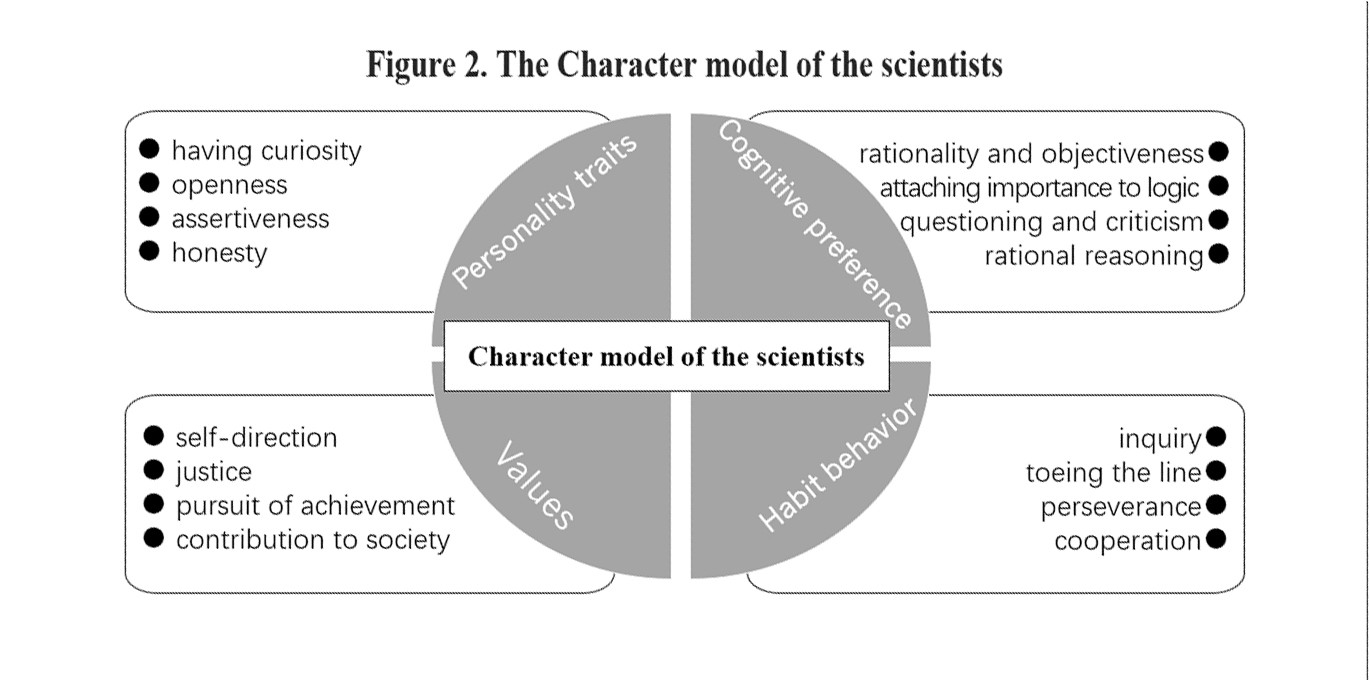
科学家特质的四个维度包括:人格特质、认知偏好、价值观及习惯行为(见表2)。
Table 2. The dimensional structure of the character model of the scientist (CMS)
Dimension | Description |
Personality traits | The four most common personality traits that scientists generally have: having curiosity, openness, assertiveness, honesty. |
Cognitive preference | The four most common cognitive preferences that scientists generally have: rationality and objectiveness, attaching importance to logic, questioning and criticism, rational reasoning. |
Values | The four most common values that scientists generally have: self-direction, justice, pursuit of achievement, contribution to society. |
Habits behaviors | The four most common habits and behaviors that scientists generally have: inquiry, toeing the line, perseverance, cooperation. |
4 科学家特质模型
本文综合了多领域既往研究内容,并结合当代心理学、行为科学及伦理学的研究成果,提出了科学家特质模型(CMS,见图2)。需要特别说明的是,关于CMS的结构维度,每个维度所归类的四个要素并非该维度所有要素的完整列表,仅涵盖最基础且高频出现的四个要素。此外,不同要素在维度分类上可能存在一定的模糊性与重叠现象。CMS由四个维度构成,每个维度包含四个要素,这些要素共同构成CMS模型。CMS模型具有以下基本特性:(1)这四个维度全面涵盖了先天遗传与智力因素、人格特质、思维模式、价值体系及习惯行为,体现了内在的结构的相对完整性。(2) 该模型显著影响行为的激活、维持及最终结果。 (3) 模型中的人格维度对其余三个维度施加特定限制或产生相应影响。 (4) 模型中的各维度不可相互替代。 (5) 模型中某些维度之间存在互补关系。(6) 在每个维度中,所有要素具有同等权重。 (7) 在每个维度中,各因素不可相互替代。 (8) 每个维度内的某些要素表现出互补特性。同时,本文还阐述了CMS在科学教育、科学传播、公众理解科学和科学研究实践方面的作用。
5 限制与未来研究
本研究结果主要基于理论分析,缺乏实证验证的证据支持。在科学家特质的定义中可能存在文化偏见,且各概念维度之间可能存在重叠。未来研究应通过开发并验证适用于CMS的测量量表(包括采用探索性因子分析和验证性因子分析)来解决这些局限性。此外,需要开展科学教育、科研人员培养与选拔、科学研究实践等领域的实证研究,以进一步评估和支持所提出的框架。
6 结语
本研究全面阐述了科研人员的相关特征,包括人格特质、认知偏好、价值观及习惯行为。基于先前的研究成果,本研究构建了CMS的概念框架、结构维度及模型层级体系,旨在建立一套基础性的理论体系。该模型(CMS)的制定与推广旨在提升研究人员遴选的客观性及研究人员培养的效率,从而最终推动科学研究的发展。这项工作对科学传播、公众对科学的理解、科学教育以及科学文化的发展也可能产生更广泛的影响。
二0二六年四月二十九日
Contact:zhoujian.china@aliyun.com
https://wap.sciencenet.cn/blog-1248178-1532787.html
上一篇:博士就业前的自我分析与思考