With the advent of the 6G era, communication systems are encountering major challenges, including the explosive growth in data scale and complexity as well as the rapidly increasing demand for real-time intelligent decision-making. Traditional communication paradigms based on bit transmission and discriminative artificial intelligence (AI) models struggle to meet the future network’s requirements for generalization, robustness, and adaptability. To achieve a paradigm shift from “connected intelligence” to “cognitive intelligence”, Agentic AI, which is powered by Large AI Models (LAMs), is emerging as a key direction for driving the intelligent evolution of 6G networks.
LAMs possess powerful capabilities for knowledge abstraction, cross-modal understanding, and content generation, enabling them to efficiently perform critical tasks in 6G networks such as semantic communication, resource scheduling, channel modeling, and network optimization. However, conventional LAMs typically rely on offline training and lack the abilities of real-time sensing, continual learning, and autonomous optimization, making them ill-suited for dynamic and complex communication environments. Against this backdrop, the concept of Agentic AI has emerged. The core idea of Agentic AI is to use large models as the “cognitive core”, while integrating key modules for perception, memory, decision-making, and planning to construct intelligent agent systems with environmental interaction, autonomous reasoning, and dynamic optimization capabilities. By forming a closed loop of “perception–cognition–action–feedback”, Agentic AI enables adaptive decision-making and efficient collaboration across multi-task, multi-modal, and multi-scenario 6G networks.
Although the potential of LAMs and Agentic AI in 6G communication systems is vast, their practical deployment faces several critical challenges. These include achieving efficient collaboration and control among multiple intelligent agents, enabling robust task planning and decomposition in dynamic environments, developing unified frameworks for agent performance evaluation, and ensuring data security and trustworthy privacy protection. This Special Issue (SI) aims to systematically investigate the key scientific and engineering challenges associated with integrating LAMs and Agentic AI into 6G networks. The focus is on uncovering the underlying integration mechanisms, establishing solid theoretical foundations, and exploring the application prospects of these technologies within communication systems. By doing so, the project seeks to advance both fundamental understanding and technological innovation in intelligent 6G networks.
1. Scope of Topics
Topics of interest include, but are not limited to:
LAMs and Agentic AI for Semantic Communication and Intelligent Perception
LAMs and Agentic AI for Multi-Agent Communication Coordination and Resource Management
LAMs and Agentic AI for Adaptive Network Slicing and System-Level Optimization
LAMs and Agentic AI for Digital Twins and Cyber–Physical Integrated Communications
Multimodal Fusion for Collaborative Agent Mechanisms in Intelligent Communication Systems
Memory- and Knowledge-Augmented Approaches for Communication Task Planning and Decision Reasoning
LAMs and Agentic AI for Continual Learning and Autonomous Optimization in 6G
LAMs and Agentic AI for Channel Modeling and Network Design
LAMs and Agentic AI for 6G Network Security, Privacy, and Trustworthy Communications
LAMs and Agentic AI for Communication Prototype Systems and Validation Platforms
2. Submission Guidelines
Authors should prepare papers in accordance with the format requirements of Tsinghua Science and Technology, with reference to the Instruction given at https://www.sciopen.com/journal/1007-0214, and submit the complete manuscript through the online manuscript submission system at https://mc03.manuscriptcentral.com/tst with manuscript type as “ Special Issue on From Large AI Models to Agentic AI: A Road Map to 6G”.
3. Important Dates
Deadline for submissions: March 31, 2026
4. Guest Editors
Cunhua Pan, Southeast University, China
Feibo Jiang, Hunan Normal University, China
Kezhi Wang, Brunel University of London, U.K.
Marco DI RENZO, CentraleSupelec, France
Dusit Niyato, Nanyang Technological University (NTU), Singapore
Ekram Hossain, University of Manitoba, Canada
Tsinghua Science and Technology 期刊介绍

Tsinghua Science and Technology是清华大学主办的第一本自然科学类英文期刊。2011年,本刊改版为信息科学类专业期刊,主要瞄准国家创新发展关键领域和战略方向,立足信息科学领域全球最新研究成果,全面反映人工智能、大数据、信息与通信工程、控制科学与工程、计算机科学与技术、软件工程等方面最新原创性研究成果,旨在为信息科学的研究和发展搭建了国际化学术交流平台。专业化转型后,本刊进入快速发展阶段,在学术质量及国际影响力上都得到了很大的提升,陆续被SCIE、SCOPUS、EI、CSCD等国内外数据库收录;2018年,期刊荣获“第四届中国出版政府奖期刊提名奖”;2019~2023年入选“中国科技期刊卓越行动计划”梯队期刊项目;2024年入选中国科技期刊卓越行动计划二期英文领军期刊项目;2025年入选北京市“2025支持高水平国际科技期刊建设-强刊提升类”项目。
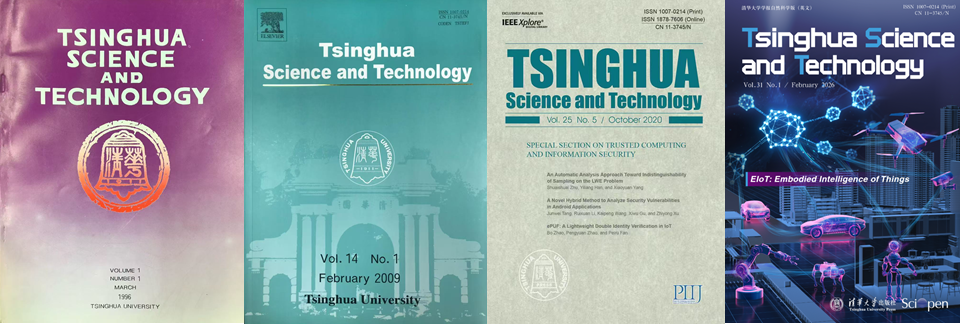
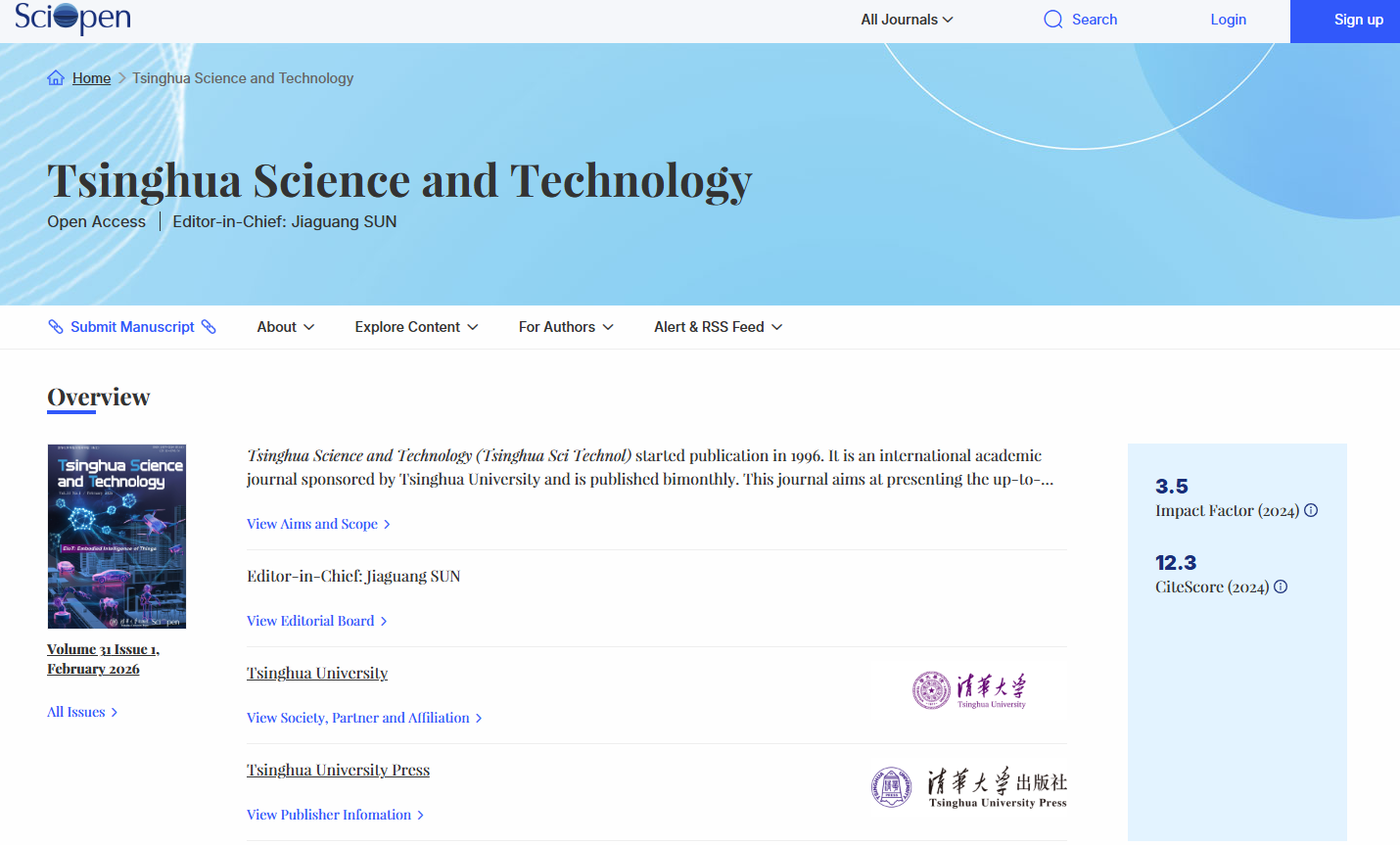
经过十余年的努力,本刊受到了全球信息科学领域学者认可,国际稿源稳步提升,读者来自全球130多个国家及地区。2025年8月,Tsinghua Science and Technology第31卷第1期正式在清华大学出版社SciOpen平台出版发布,标志着Tsinghua Science and Technology结束了“借船出海”的办刊模式,回归本土独立运营!
SciOpen是由清华大学出版社自主研发的科技期刊国际化数字出版平台,于2022年6月正式上线。截至目前,SciOpen平台目前已汇聚195种期刊,上线超过5.8万篇文章,2025年7月访问量突破960万次,用户遍布190多个国家和地区。SciOpen平台已实现与国际通用搜索引擎、出版标准化组织及重要学术索引数据库的全面对接,运行稳定、服务可靠,为Tsinghua Science and Technology回归后的持续发展提供了坚实技术支撑和全球化传播保障。
未来,Tsinghua Science and Technology将继续聚焦信息科学前沿和热点研究,依托SciOpen平台先进的服务能力,为我国乃至全球的信息科学领域发展贡献更多的智慧与力量。
01 期刊特色
● 开放获取:用户免费阅读下载
● 高质量同行评审
● 即时发布:论文接收后48小时内在线发表
● 开设绿色通道:加速高水平和突破性成果的发表流程
● 国际化宣传推广:依托SciOpen平台立体化的宣传推广体系,全方位提升学术成果的国际显示度和学术影响力
02 关于期刊
期刊官网:https://www.sciopen.com/journal/1007-0214
投稿网址:https://mc03.manuscriptcentral.com/tst
《清华大学学报自然科学版(英文)》2024年度优秀论文和最佳优秀论文奖揭晓
转载本文请联系原作者获取授权,同时请注明本文来自清华大学出版社学术期刊科学网博客。
链接地址:https://wap.sciencenet.cn/blog-3534092-1545112.html?mobile=1
收藏