“辣椒丝,侬欢喜伐”是个什么梗?
我的答案是:
上海话:辣椒丝,侬欢喜伐?=====普通话:辣椒丝,你喜欢吗?
辣椒丝,是LAGEOS的汉语谐音。
LAGEOS,可以拆分为LA 、GEO和S它们,分别是激光(LAser )的前两个字母、地球动力学(GEOdynamics)的前三个字母和卫星(Satellite)的首字母。在意大利语中,LA是阴性名字的定冠词。
LAGEOS-1是美国的;LAGEOS-2属于美国和意大利。它俩从外观上看,极为相似,堪比双胞胎。它们,最初是为研究大地测量学发射的。
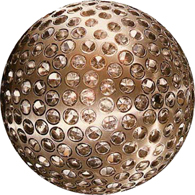
LAGEOS卫星
LAGEOS-1,-2卫星分别于1976和1992年。两个卫星的轨道参数,如下。

LAGEOS实际上是一颗直径60 cm 、表面布满426个角反射器(后向反射器——反射激光与入射激光平行的特制光学器件)的圆球。 LAGEOS-1,-2运行周期分别为225和223分钟;轨道高度分别为5860公里和5620公里。它俩的预期寿命相当长久。
作为轨道较高激光测距卫星,它们是比较容易观测的。数十年来,这两颗激光卫星,为地球动力学研究提供了大量数据。
原定于今年7月发射的LAGEOS-3卫星,一直未见报道。
--------------------------------------参考文献 来自 ILRS ----------------------
【LAser GEOdynamics Satellite-1 (LAGEOS) was designed by NASA and launched in 1976. It was the first spacecraft dedicated exclusively to high-precision laser ranging and provided the first opportunity to acquire laser-ranging data that were not degraded by errors originating in the satellite orbit or satellite array. LAGEOS-2, based on the LAGEOS-1 design, was built by the Italian Space Agency and was launched in 1992.
There are plans for the launch of LAGEOS-3, which is a joint multinational program with collaboration from France, Germany, Great Britain, Italy, Spain and the United States. Data from LAGEOS-3 would be used to measure, for the first time, a quasi-stationary property of the Earth - its gravitational magnetic dipole moment as predicted by Einstein's theory of general relativity.】
转载本文请联系原作者获取授权,同时请注明本文来自籍利平科学网博客。
链接地址:https://wap.sciencenet.cn/blog-255-1505875.html?mobile=1
收藏