,,,,,,
https://doi.org/10.1016/j.snb.2026.139615
Sensors and Actuators B: ChemicalVolume 454, 1 May 2026, 139615
aNHC Key Laboratory of Tropical Disease Control, Engineering Research Center for Hainan Bio-Smart Materials and Bio-Medical Devices, Key Laboratory of Hainan Functional Materials and Molecular Imaging, School of Life Sciences and Medical Technology, Hainan Medical University, Haikou, Hainan 571199, China
bDepartment of Urology, Hainan General Hospital, Affiliated Hainan Hospital of Hainan Medical University, Hainan Provincial Clinical Medical Center, Haikou, Hainan 570311, China
cKey Laboratory of Emergency and Trauma, Ministry of Education, Key Laboratory of Haikou Trauma, Key Laboratory of Hainan Trauma and Disaster Rescue, The First Affiliated Hospital, Hainan Medical University, Haikou, Hainan 571199, China
dCollege of Pharmacy, Hainan Medical University, Haikou, Hainan 571199, China
Received 23 October 2025, Revised 25 January 2026, Accepted 4 February 2026, Available online 5 February 2026, Version of Record 10 February 2026.
ighlights•A BBB-permeable NIRF probe DCICF3-CP enabled imaging of BChE activity in neuroinflammation and Alzheimer’s disease.
•Elevated BChE activity was associated with the progression of Alzheimer’s disease.
•DCICF3-CP visualized the potential neuroprotective effects of atorvastatin in neuroinflammation.
Abstract
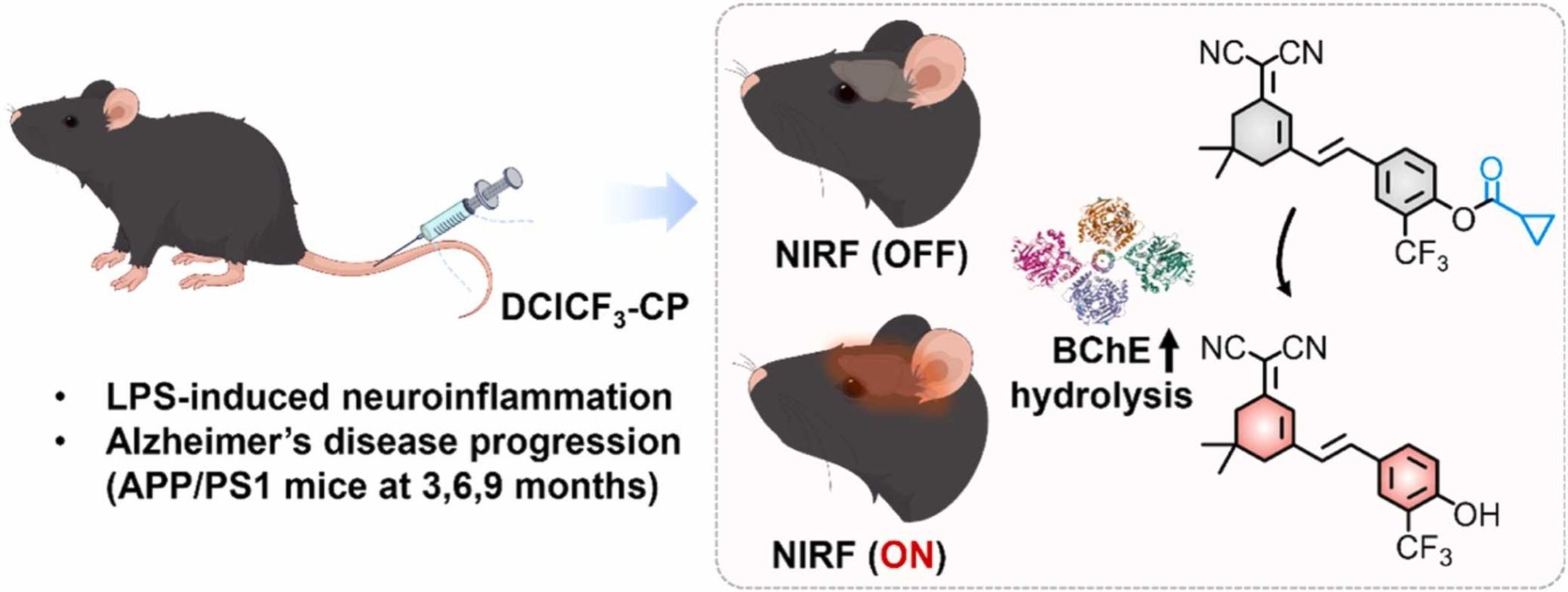
Alzheimer's disease (AD) is a neurodegenerative disorder characterized by progressive memory loss and cognitive impairment, with neuroinflammation and cholinergic dysfunction playing pivotal roles in its pathological progression. Butyrylcholinesterase (BChE), beyond its hydrolytic function in the periphery, is markedly upregulated in the brains of patients with mid to late-stage AD. However, real-time visualization of BChE activity in neuroinflammatory and AD models remains challenging due to the limited availability of imaging probes that combine high selectivity with efficient blood-brain barrier (BBB) permeability. In this work, an activatable near-infrared fluorogenic (NIRF) probe, DCICF3-CP, was designed and synthesized for in vivo imaging of BChE activity in neuroinflammatory and AD models. This probe employed dicyanoisophorone (DCI) as its near-infrared fluorophore and incorporated a cyclopropyl ester as a BChE-specific recognition unit. Concurrently, trifluoromethyl groups were introduced onto the aromatic ring to enhance lipophilicity and facilitate BBB permeability. Upon BChE hydrolysis, the cyclopropyl was cleaved, releasing the product DCICF3, enabling a turn-on fluorescence response. Cellular studies demonstrated that DCICF3-CP could track BChE upregulation in glutamate- and Aβ42-induced AD-related models. In vivo imaging further revealed significantly elevated BChE activity in LPS-induced neuroinflammatory mice, with decreased fluorescence signals following atorvastatin (Atv) intervention, indicating Atv treatment mitigated neuroinflammation. Moreover, imaging results from AD transgenic mice showed a gradual increase in brain BChE activity with age, consistent with Western blot analysis. Collectively, the developed DCICF3-CP was suitable for real-time visualization of BChE-related neuroinflammation and AD pathological processes, providing a novel tool for studying the mechanisms of neurodegenerative diseases and evaluating therapeutic interventions.
转载本文请联系原作者获取授权,同时请注明本文来自于法标科学网博客。
链接地址:https://wap.sciencenet.cn/blog-2438823-1521845.html?mobile=1
收藏