博文
2026年01月嘲风作品集(一)
||
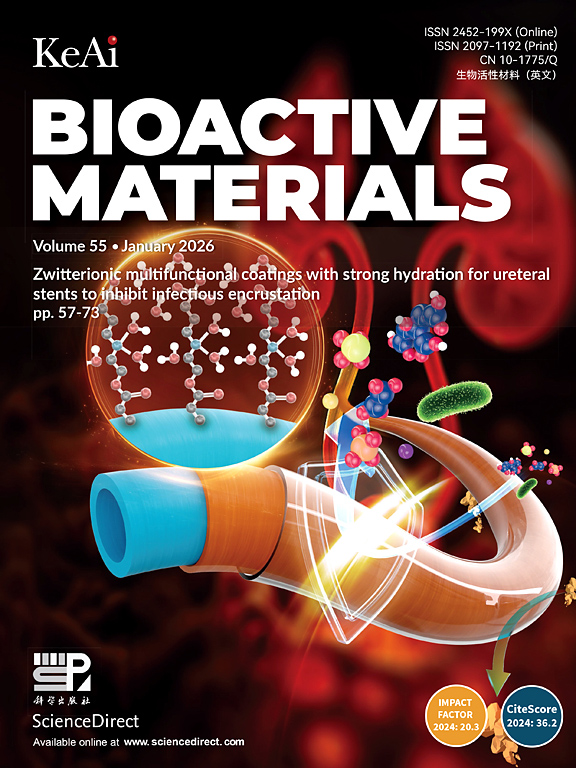
Zwitterionic multifunctional coatings with strong hydration for ureteral stents to inhibit infectious encrustation
Yucong Wu, Zhenqing Li, Xiufang Wen, Yanping Zhong, Haoyan Chen, Lei Qian, Jiawei Li, Sujuan Yan, Peng Yu, Ye Tian, Haoyu Jin, Zhengao Wang, Jinxia Zhai, Chengyun Ning
In the complex urinary environment, an effective method is needed to combat ureteral stent encrustation. Herein, recognizing that the adsorption of mineral salts is the initial step in the encrustation process, we utilized the barrier effect of hydration layers to inhibit encrustation. Through molecular dynamics simulations, sulfobetaine methacrylate can form a hydration layer, which repels encrustation ions in a simulated urinary environment, preventing attachment. Then, we developed a multifunctional zwitterionic polymer coating on the polyurethane stent (PU/ATS) by employing UV-initiated free radical polymerization combined with a dip-coating technique. The hydration layer endows the coating with superhydrophilicity and excellent lubricity, effectively resisting 96.1 % and 83.5 % of encrustation in 30 days and 90 days of urine flow simulation and significantly reducing the bacteria adhesion. PU/ATS demonstrated improved anti-encrustation and anti-biofilm performance under infected conditions compared to the Bard® InLay Optima® stent. Moreover, in the rat bladder encrustation model, the PU/ATS reduced encrustation by 99.6 % (no infected) and by 86.7 % (infected) without organ damage. Therefore, the PU/ATS, by leveraging the hydration layer mechanism as an effective barrier, provides a practical and highly promising solution to combat encrustation and its associated urological complications.
https://www.sciencedirect.com/science/article/pii/S2452199X25003688
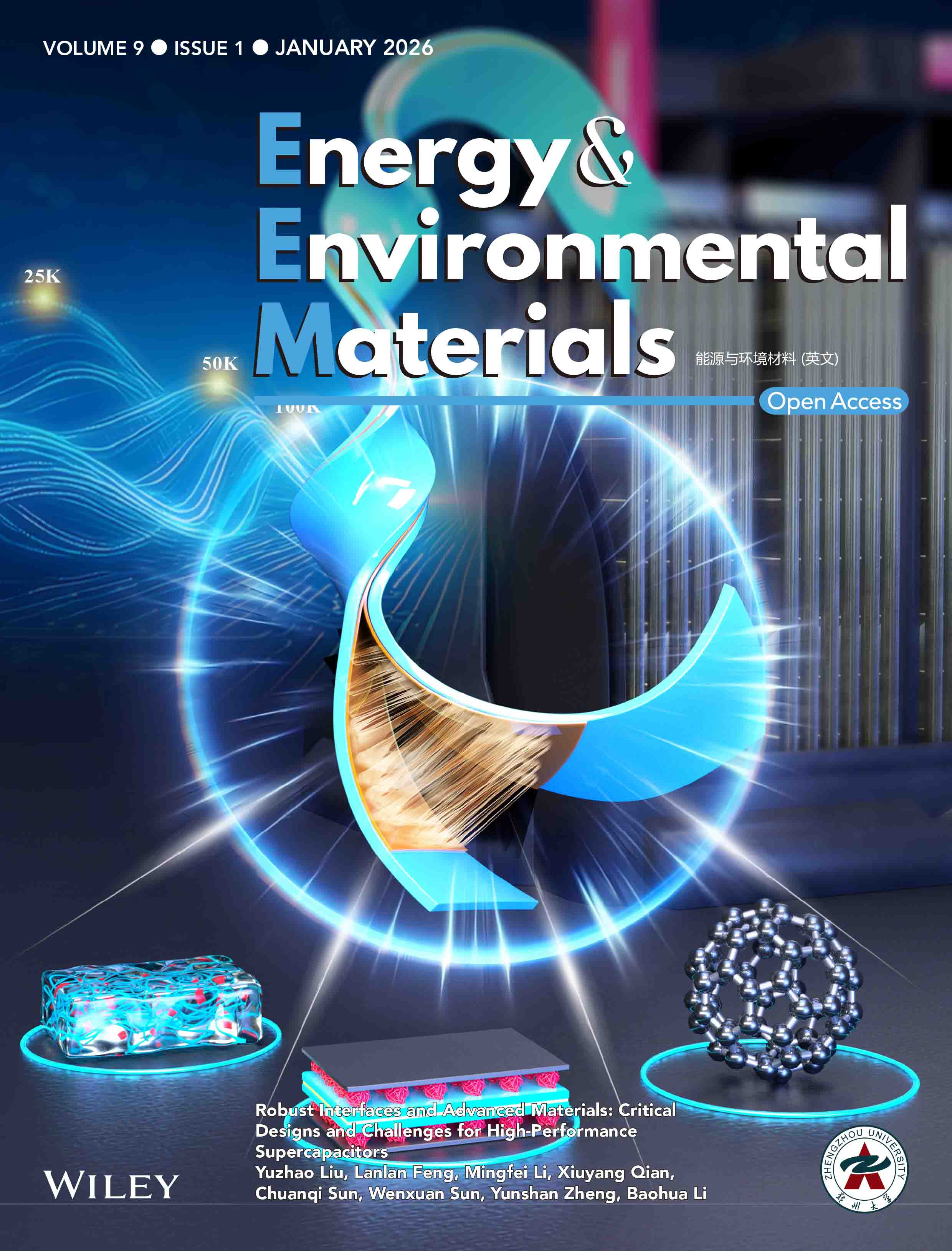
Robust Interfaces and Advanced Materials: Critical Designs and Challenges for High-Performance Supercapacitors
Yuzhao Liu, Lanlan Feng, Mingfei Li, Xiuyang Qian, Chuanqi Sun, Wenxuan Sun, Yunshan Zheng, Baohua Li
With the growing global energy demand and the pressing need for a clean energy transition, supercapacitors (SCs) have demonstrated significant application potential in electric vehicles, wearable electronics, and renewable energy storage systems owing to their rapid charge–discharge capability, exceptional power density, and prolonged cycle life. The improvement of their overall performance fundamentally depends on the synergistic design of electrode materials and electrolyte systems, as well as the precise regulation of the electrode-electrolyte interface. This review focuses on the key components of supercapacitors, systematically reviewing the design strategies of high-performance electrode materials, outlining recent advances in novel electrolyte systems, and comprehensively discussing the critical roles of interfacial reinforcement and optimization in enhancing device energy density, power performance, and cycling stability. Furthermore, interfacial engineering strategies and innovations in device architecture are proposed to address interfacial degradation in flexible SCs under mechanical stress. Finally, key future research directions are highlighted, including the development of high-voltage and wide-temperature-range electrolyte systems and the integrated advancement of multiscale in situ characterization techniques and theoretical modeling. This review aims to provide theoretical guidance and innovative strategies for material design, contributing toward the realization of next-generation supercapacitors with enhanced energy density and reliability.
https://onlinelibrary.wiley.com/doi/10.1002/eem2.70116
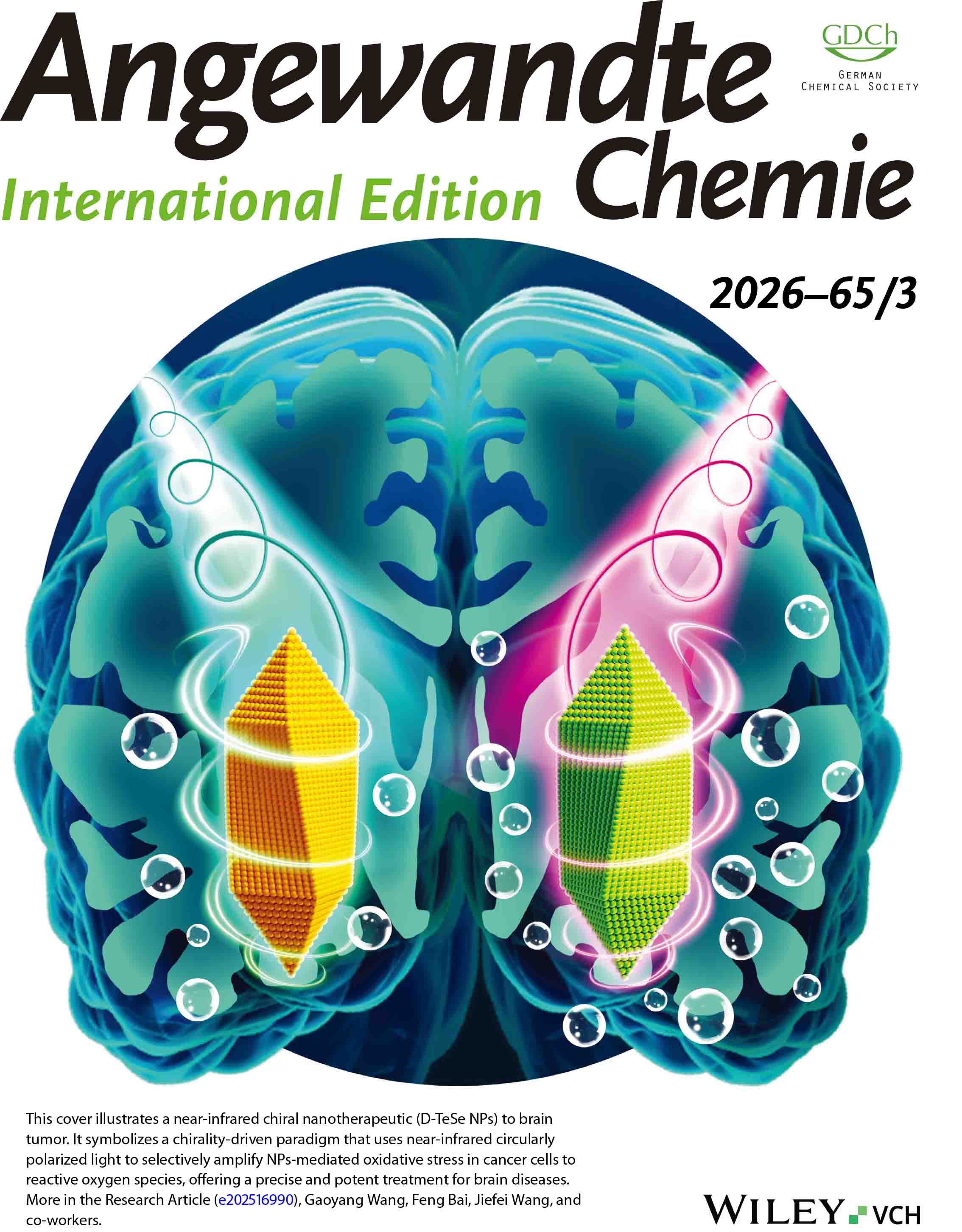
Inside Front Cover: Brain-Targeted Near-Infrared Chiral TeSe Nanodrug Against Orthotopic Drug-Resistant Glioma
Yisheng Liu, Xi Li, Qingxiang Zhu, Yong Zhong, Xuhong Lin, Chaoqun Zhou, Cai Qi, Jincheng Guo, Qinqin Ma, Haigang Wu, Gaoyang Wang, Feng Bai, Jiefei Wang
This cover illustrates a near-infrared chiral nanotherapeutic (D-TeSe NPs) to brain tumor. It symbolizes a chirality-driven paradigm that uses near-infrared circularly polarized light to selectively amplify NPs-mediated oxidative stress in cancer cells to reactive oxygen species, offering a precise and potent treatment for brain diseases. More in the Research Article (e202516990), Gaoyang Wang, Feng Bai, Jiefei Wang, and co-workers.
https://onlinelibrary.wiley.com/doi/10.1002/anie.2025-m2112093200
<静远嘲风-南京>设计制作
购书链接:
☆科学的颜值:学术期刊封面故事及图像设计
https://item.jd.com/12802188.html
☆科技绘图/科研论文图/论文配图设计与创作自学手册:CorelDRAW篇
https://item.jd.com/13504674.html
☆科技绘图/科研论文图/论文配图设计与创作自学手册:Maya+PSP篇
https://item.jd.com/13504686.html
☆科技绘图/科研论文图/论文配图设计与创作自学手册:科研动画篇
https://item.jd.com/13048467.html#crumb-wrap
☆SCI图像语法-科技论文配图设计使用技巧
https://item.jd.com/10073529532924.html?bbtf=1
静远嘲风-南京(MY Scimage) 成立于2007年,嘲风取自中国传统文化中龙生九子,子子不同的传说,嘲风为守护屋脊之瑞兽,喜登高望远;静远取自成语“宁静致远”,登高莫忘初心,远观而不可务远。

学习更多绘图教程关注:


https://wap.sciencenet.cn/blog-519111-1525174.html
上一篇:《解决碱性水电解难题,推动绿色氢能发展》
下一篇:2026年01月嘲风作品集(二)